
Your biggest marketing line item has a hole in it.
Trade shows take roughly a third of the B2B marketing budget. Then, industry estimates suggest, as many as 80% of the leads any event produces are never contacted.[6] This page lists those leaks, with sources, and provides the patch.
Exhibit 02 · Where the leads go
The lead gets captured, then dies in the gap between capture and contact.
Illustrative narrowing. The only cited anchor is the industry estimate that as many as 80% of event leads never get followed up on.[6]
Exhibit 03 · The speed forfeit
Respond within an hour and you are nearly 7x more likely to reach a decision maker than a rival who waits just one hour longer. Wait a day and it is 60x.[1]
"Time kills all deals."
Old sales-floor wisdom. The data below is why it's still true.
The odds collapse as minutes pass[1]
Respond in 5 minutes instead of 30
Respond within an hour instead of a day or more
Exhibit 04 · The write-off
Whatever the budget, the same percentage buys silence.
For reference, not a universal number
Not every company runs $150K trade show programs. Many run several $3,000 to $8,000 regional events a year instead, and the leak scales with the budget either way: industry estimates suggest, as many as 80% of leads at any size event never get a follow-up.[6] For a modest $5,000 event capturing around 35 leads, that is roughly $4,000 of spend that produced nothing. For scale: leads followed up within 7 to 10 days convert to opportunities 20 to 30% of the time.[8]
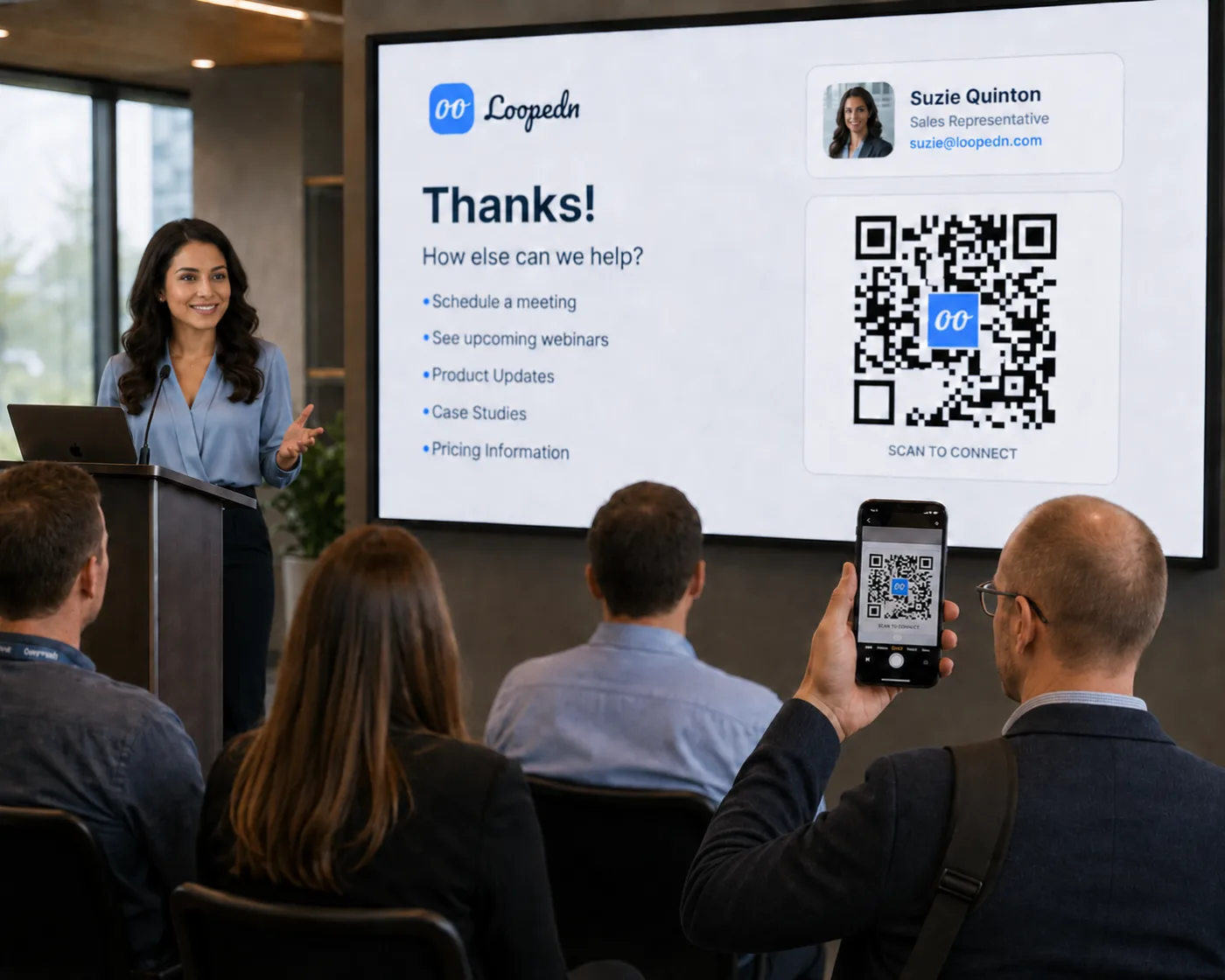
Here's where the leak stops
One scan. One second. One less lost lead.
Loopedn closes the gap
Attendees scan a QR code and fill out a short form. Everything after that, the part where leads die, happens in seconds instead of days.
Your follow-up lands before their next conversation.
The AI writes a personalized follow-up from what the attendee actually asked about and sends it seconds after the scan, from your rep's name, with links to the resources they picked on the form. You can always be the first to respond.
7x more likely to reach a decision maker if you answer within the hour.[1]
To: dana.k@meridian.example · Tue 10:15 AM
Hi Dana, great talking with you at ABC Conference today in Indianapolis. You asked about our security review process:
- SSO setup takes under a day
- SOC 2 report available on request
Every lead lands with its owner, instantly.
Routing rules assign each lead by territory, role, or any variable you define, the moment it is captured, source-tagged to the event. No export, no import, no "whose lead is this" meeting.
Reps already spend about 70% of their time on non-selling tasks.[7]
Routing rule
If State isFlorida
route to Tommy TorresActive
Your rep opens the call with what the lead asked for.
Every lead includes its context in the attendee's own words, an A/B/C score, company enrichment, and the event it came from. Nothing to reconstruct from a cold badge scan a week later.
Roughly 76% of booth visitors are new contacts, not current customers. Context is the whole game.[4]
Dana K.
Director of IT · Meridian Health
Attendees pick their resources. Delivered in seconds.
They select the resources they want and are emailed exactly those. The picking is itself a buying signal your rep can open with, and there is no print bill, no shipping, nothing left in a hotel trash can.
60 to 70% of B2B marketing content goes unused by sales anyway.[2]
Which resources would you like?
Attribution is budget defense
The one who scanned badges, blasted one generic email, and tracked nothing reports the show "was okay" and gets cut.[9] The exhibitor who can say "this show produced 80 leads, with 5 advanced into deals" walks into next year's budget meeting with an ROI story. Loopedn source-tags every lead, logs every follow-up, and scores how hot each one was, so the lead count and the follow-up record behind that story are already gathered for you. Which ones closed still comes from your CRM.
Free plan, no credit card, 50 leads per event.
Appendix · Sources
- [1] Harvard Business Review, "The Short Life of Online Sales Leads" (Oldroyd, McElheran, Elkington), March 2011. Audit of 2,241 U.S. companies. https://hbr.org/2011/03/the-short-life-of-online-sales-leads
- [2] SiriusDecisions (now Forrester): 60 to 70% of B2B marketing content goes unused by sales. Stated at SiriusDecisions Summit 2013; confirmed on Forrester's blog. https://www.forrester.com/blogs/its-not-content-its-a-lack-of-buyer-insights-thats-the-problem/
- [3] CEIR data via industry analysis: trade shows are the single largest B2B marketing line item at roughly 31.6% of budgets. https://emitree.com/blog/conference-roi
- [4] PurExhibits, Trade Show Statistics 2026 (citing CEIR and EXHIBITOR research). https://www.purexhibits.com/trade-show-statistics-2026/
- [5] Lensmor: fully loaded cost per qualified booth conversation. https://www.lensmor.com/blog/event-intelligence-trade-show-roi
- [6] SurFox: illustrative exhibitor economics on trade show lead follow-up failure. The widely repeated 80% figure has no locatable primary study; we frame it as an industry estimate. https://www.getsurfox.com/blog/trade-show-lead-follow-up-failure
- [7] Cirrus Insight, sales follow-up statistics roundup: rep time spent on non-selling tasks. https://www.cirrusinsight.com/blog/sales-follow-up-statistics
- [8] Default: conversion rates when event leads are followed up within 7 to 10 days. https://www.default.com/post/following-up-on-trade-show-leads
- [9] VenueSight: how exhibitors measure (and lose) trade show ROI attribution. https://venuesight.com/blog/how-exhibitors-measure-trade-show-roi
- [10] Prospeo: badge-scan data quality and email deliverability problems. https://prospeo.io/s/following-up-on-trade-show-leads
- [11] Trade Show PRO, Trade Show Statistics 2026: digital lead capture adoption. https://tradeshowpro.events/blog/trade-show-statistics-2026/
Last reviewed July 2026. All links verified at time of publication. Where industry figures are widely repeated but lack a locatable primary study, we say so and frame them as estimates.